
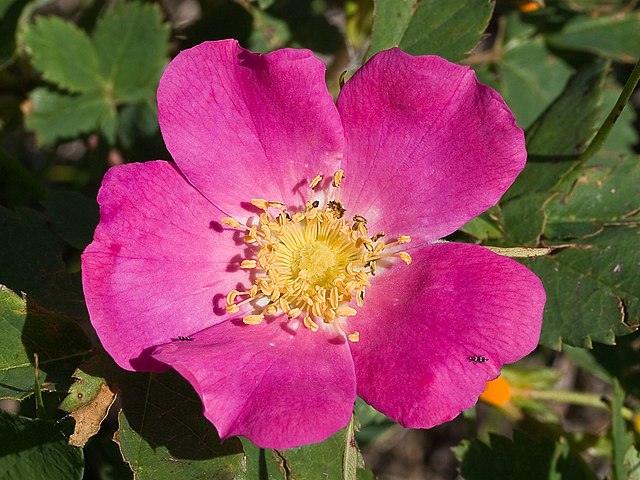
Rosa woodsii (Western Wild Rose) is an upright, deciduous, rhizomatous shrub with attractive, deep green pinnately compound leaves divided into 5-9 finely toothed leaflets. In spring, its new canes emerge red and are lined with prickles on their lower portions. In late spring to mid-summer, a profusion of very fragrant, single, pink to lilac-pink, or lavender flowers, up to 4 in. across (10 cm), are borne in small clusters. The flowers are attractive to bees and other pollinators. They are followed by abundant fleshy, red, round, or pear-shaped hips that generally persist on the bush throughout the winter. The hips are a source of vitamin C and are dried for use in flavoring teas, jellies, fruitcakes, and puddings. Many birds and mammals feast on them. Rosa woodsii produces flowers and fruits at about 2-5 years of age. Good crops are usually produced every 2 years. Long-lived, Western Wild Rose sometimes forms nearly impenetrable thickets thanks to its shallow, frequently branching fibrous roots. It is effective in erosion control, but can also be used as an ornamental near homes to attract birds and other wildlife.
| Requirement | |
|---|---|
| Hardiness | 3,4,5,6,7,8 |
| Heat Zones | 3,4,5,6,7,8 |
| Climate Zones | 3, 4, 5, 6, 7, 8 |
| Plant Type | Shrubs |
| Plant Family | Rosacea |
| Exposure | Full Sun, Partial Sun |
| Season of Interest | Spring, Summer, Fall, Winter, Late Spring, Early Summer, Mid Summer |
| Height | 5' - 6' |
| Spread | 5' - 6' |
| Water Needs | Average |
| Maintenance | Average |
| Soil Type | Clay, Loam, Sand |
| Characteristics | Drought Tolerant |
| Garden Styles | Informal and Cottage, Prairie and Meadow |
| Planting Place | Beds and Borders |